Projects
Lamp-Man
The idea for my first original artwork came from a challenge I proposed to myself, which consisted of creating a whole scene with a single reference photo during the afternoon.

Eyes on the Plate
My first piece of conceptual art was made based off the feeling of uncanny. As humans, we are compelled to project our own nature onto nature; so, we will often recognize faces where there are none. The eyes on the plate invoke the idea that we are looking at someone, even though there is no one there.

Windflower
My first not-a-GIF animation was also the project I put the most effort in--the 3D rendering alone, not accounting for the editing rendering on DaVinci Resolve 17, took me 44 hours.

Project Boost
My first complete game project was made as homework for an Udemy course called "Complete C# Unity Game Developer 3D", but I worked a lot to extrapolate what was done in the course, modelling my own assets, creating my own level designs and coding new mechanics for the game, like a fuel system.

Chess Set
Game asset based off a Udemy course's low-poly chess set. Although, I chose to not go with a low-poly approach, which is why I could not make the knight pieces, as they would require organic modeling, something I was not studying at that time.

Strike
Bowling ball and pins project homework from the Udemy's course "Complete Blender Creator: Learn 3D Modelling for Beginners". Learning how to use curves, creating solids of revolution, basics of textures on the shader editor and hard-surface modeling.
.jpg)
VSS Unity at the Edge of Space
This project was a homage to the first comercial flight of Virgin Galactic, which, despite not passing the Karman Line, and therefore not being technically "the edge of space", represented a huge moment for space turism.
.jpg)
Want Some Donut
My first ever complete project was made following the now famous donut tutorial by Blender Guru. This project taught me the basics of modeling, shading, compositing and even editing. To make my donut different, though, I covered it in hot chocolate instead of pink frost.

Just Wine
Study on refractive index to differentiate between glasses and liquids. The wine material also required volume absorption to faithfully depict the gradual darkening of the drink as of closer to the bottom of the glass.

Sinus
Reference study in which I tried to recreate whatever was closest to me at the time, which happened to be a syringe and a sinus rinse, as photorrealistically as possible. That was the first time I used a software besides Blender, GIMP 2.10, to make materials.

Landing Rocket
This rocket was designed to be part of a space exploration game project of mine. I modelled it in accordance with the mental image I had for a rocket toy. The exhaustion flame was animated with mantaflow.

Home
Collection of all of my attempts to recreate the Earth. This one in particular, I made using NASA's publicly available ultra-resolution (21k) textures. The atmosphere, on the hand, was shaded using a fresnel map as a texture coordinate for the emission shader, which was then streghtened by a Multiply math operation.

Sword
A game asset I made following CG Fast Track sword tutorial, which is significantly more advanced than the donut tutorial, especially for the hard-surface modeling.

The Well
A fairly simple project, but there's nothing wrong with simplicity. Through this well, I learned more about the array modifier, which helped me place the bricks. Apart from that, the whole piece was a work of patience, modeling and global/local transformations.

The Fan
Personal project working with visual reference: my room's ventilator. I had to use curves for the blades, the upper protection and the base (not visible in the preview below).

Lilalia
Inspired by Sebastian Lague's Coding Adventures: coding procedural planets and moons, I decided to create my very own procedural celestial bodies. But instead of using Unity and C#, I'd be using Blender's Shader Editor. This os the work that made me fall in love with ColorRamp.
.jpg)
Big Orange Rocket
Recreation of the upcoming Block-2 cargo version of NASA's Space Laungh System (SLS), which aims to take the first woman and the first person of color to the moon as part of the mission for the Artemis program.

Low-Poly Rocket
Creative homework for the Udemy's course "Complete Blender Creator: Learn 3D Modelling for Beginners". I chose to model this stylized low-poly rocket, with two solid boosters attached laterally and three stages indicated through black decouplers.

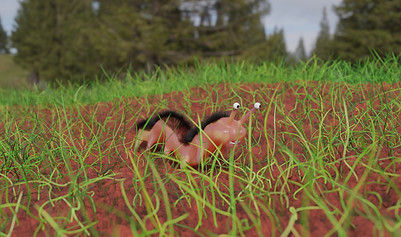
Harry, the Hairy Slug
My first time working with metaballs and sculpting. Both the hairs on the back of the creature and the grass on the ground were made using hair particle system--the grass required an image texture to be colorfully diverse, adding to the realism.